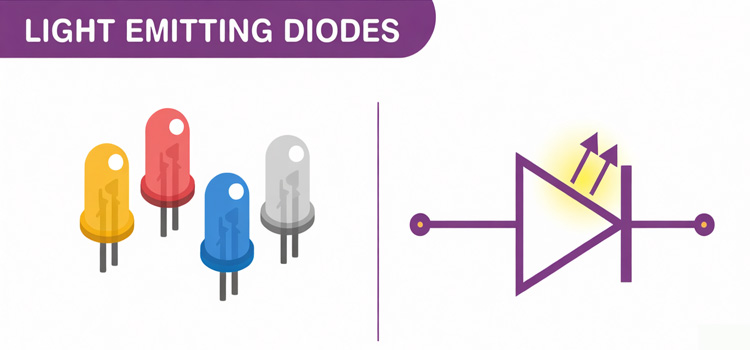
A light-emitting diode (LED) is a semiconductor device that emits light when an electric current flows through it. When current passes through an LED, the electrons recombine with holes emitting light in the process. LEDs allow the current to flow in the forward direction and blocks the current in the reverse direction.
Light-emitting diodes are heavily doped p-n junctions. Based on the semiconductor material used and the amount of doping, an LED will emit coloured light at a particular spectral wavelength when forward biased. As shown in the figure, an LED is encapsulated with a transparent cover so that emitted light can come out.
How it works?
• An LED is a semiconductor device, meaning it's made of materials that conduct electricity.
• When an electrical current is applied, atoms in the semiconductor material release energy in the form of photons, or light.
• This process is called electroluminescence, and it's different from how traditional incandescent bulbs work, which is by heating a filament until it glows.
Advantages:
• Energy-efficient: LEDs use significantly less energy than traditional incandescent bulbs.
• Cost-effective: Due to their energy savings and longer lifespan, they can be more cost-effective over time.
• Versatile: They are a directional light source, which means they can be engineered to emit light in a specific direction, unlike other bulbs that emit light in all directions.
• Durable: They are more durable and long-lasting.