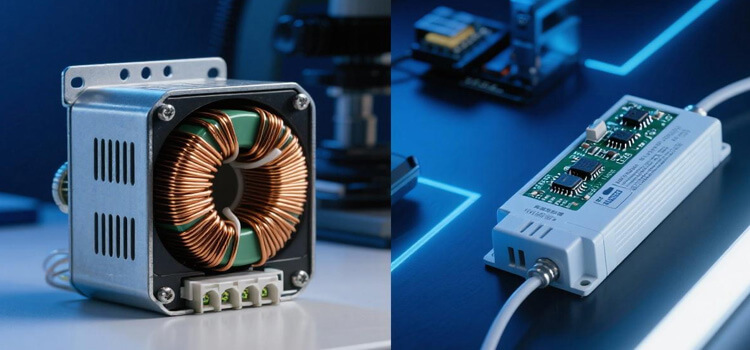
Magnetic ballasts are older, heavy, and less efficient devices that use electromagnetic induction to regulate current for lights, while electronic ballasts are newer, more efficient, and lighter, using solid-state circuitry to convert mains voltage to a high frequency for better performance, reduced flicker, and less noise. The main differences lie in their technology, efficiency, size, weight, and performance characteristics, with electronic ballasts generally offering modern advantages like dimming capabilities and faster startup.
Magnetic Ballast:
• Technology: Uses electromagnetic induction with coils and an iron core to limit current.
• Performance: Operates at a low frequency (around 50-60 Hz), which can cause noticeable flicker.
Often produces a humming noise.
Can be bulky and heavy.
• Efficiency: Lower energy efficiency compared to electronic ballasts.
• Lifespan: Can be very durable and long-lasting, but their efficiency may decrease over time.
• Compatibility: Primarily used in older fluorescent lights.
Electronic Ballast:
• Technology: Uses electronic components like transistors and capacitors to convert mains voltage to a high frequency (20-80 kHz).
• Performance: Operates at a high frequency, which eliminates flicker.
Runs silently with no humming or buzzing.
Smaller, lighter, and more compact.
Enables faster startup.
• Efficiency: Higher energy efficiency, which can lead to nearly 10% higher lamp efficiency.
• Lifespan: Generally have a longer lifespan than magnetic ballasts, especially in settings where lights are on for extended periods.
• Compatibility: Can be used with many modern lights, including some LED tubes, and often supports dimming functionality.