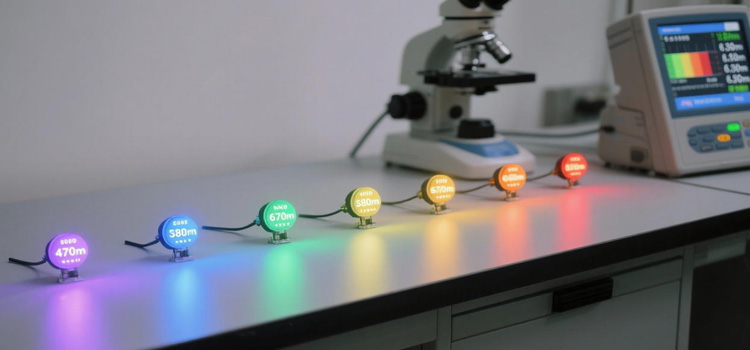
The wavelength of an LED is determined by its color, which ranges from ultraviolet (under \(380\) nm) to infrared (over \(780\) nm), with specific wavelengths for each color. The color of light emitted depends on the semiconductor material used in the LED, which dictates the energy of the photons released. For example, blue LEDs are typically between \(450\) and \(495\) nm, while red LEDs are between \(620\) and \(750\) nm.
How wavelength is determined:
• LEDs: LEDs are made of semiconductor materials. When a voltage is applied, electrons move to a higher energy level and then fall back to a lower energy level, releasing a photon of light.
• Semiconductor: The specific semiconductor material determines the "band gap," which is the energy difference the electrons fall.
• Band gap: A smaller band gap results in a longer wavelength of light (red or infrared), while a larger band gap results in a shorter wavelength (bluer light).